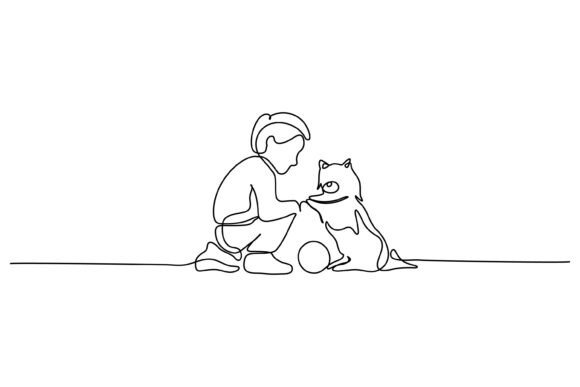
Continuous Line Design of Boy Feeding Cat
A Gentle, Flowing Sketch That Stitches With Quiet Confidence
First glance at the Continuous Line Design of Boy Feeding Cat feels like spotting a quiet moment in a sunlit kitchen—boy crouched low, cat leaning in, one unbroken line tracing both figures and their shared tenderness. There’s no bold outline, no heavy fill, no decorative border. Just rhythm: a single, confident stroke that loops, curves, pauses, and continues—like breath made visible. As an embroidery designer who’s stitched hundreds of illustrations for baby onesies, boutique aprons, and Etsy patches, I immediately sensed its potential—and its limits.
Where This Design Naturally Lives (and Thrives)
I recently tested the Continuous Line Design of Boy Feeding Cat on a natural linen tea towel for a local gift shop launch. We used a fine 40-weight cotton thread in soft charcoal, minimal stabilizer, and a 3.5" hoop. The result? Crisp, elegant, and unmistakably handmade—not “digitized,” but *drawn* with needle and thread. It worked beautifully because the design’s strength is in its simplicity and flow. It shines on:
- Lightweight apparel—think organic cotton tees, linen blouses, or baby bodysuits where subtlety reads as care;
- Home textiles—kitchen towels, pillow covers, and nursery wall hangings where gentle illustration supports calm, intentional spaces;
- Patches and appliqués—especially fused or sewn-on embroidered patches for backpacks or denim jackets, where the continuous line translates cleanly into satin-stitched edges;
- Personalized gifts—a custom sweatshirt for a new pet parent, a baby shower tote bag, or a holiday ornament stitched on wool felt.
It’s not flashy—but it’s memorable. Customers notice the intention behind it. One Etsy buyer told me she chose it for her daughter’s first birthday because “it didn’t scream ‘cartoon’—it felt like a real moment, drawn just for us.” That’s the quiet power of this design.
Real Embroidery Considerations: Where to Lean In—and Where to Pause
This isn’t a plug-and-stitch file for beginners. Its elegance depends on thoughtful execution. On stretchy fabric like jersey or thin knits, the line can waver or blur without proper cutaway stabilizer and reduced stitch speed. On dark fabric, the single-line nature means contrast is everything—I recommend testing thread colors against the final garment, not just on white mockups. And while it scales well up to 5", going smaller than 2.75" risks losing legibility in corners where the boy’s hand meets the cat’s head.
Curved surfaces—like structured caps or rounded mugs—require repositioning or digitizing adjustments. A straight-line drawing doesn’t auto-adapt to dome-shaped hoops. Likewise, textured fabrics (terry cloth, bouclé, burlap) swallow fine lines. If you’re planning a machine embroidery design for a woven cotton apron, great. For a fluffy baby blanket? Reconsider—or pair it with a simple fill-stitch base layer underneath.
What It Adds (and Doesn’t Add) to Your Finished Product
The Continuous Line Design of Boy Feeding Cat elevates perceived value by signaling craftsmanship over mass production. It reads as intentional, human-made—not algorithmic. That builds trust, especially for small shop owners and Etsy sellers whose buyers seek authenticity. It also supports brand consistency when used across product families: same line weight on a tea towel, matching patch, and greeting card illustration creates visual cohesion without repetition.
But it won’t carry a busy layout. Don’t try to crowd it with text, icons, or secondary motifs—it’s a soloist, not a chorus. And while it works for commercial embroidery, remember: the files provided (EPS, SVG, JPG) are graphic assets—not pre-digitized embroidery files. You’ll need to convert them thoughtfully, adjusting stitch type (running stitch preferred for fidelity), density (lighter is better here), and underlay (minimal or none).
Practical Designer Notes Before You Stitch
Before using the Continuous Line Design of Boy Feeding Cat in any project—personal or commercial—do these five things:
- Test on scrap fabric that matches your final substrate, with the same stabilizer and thread;
- Check thread color contrast on both light and dark backgrounds—what reads softly on ivory may vanish on navy;
- Review stitch density in your digitizing software; avoid over-stuffing curves—this line sings when it breathes;
- Confirm licensing terms before selling finished items or bundling the digital embroidery file—this is a Graphics asset, not automatically cleared for resale;
- Use black-and-white mockups to assess silhouette clarity—no color distractions, just shape and flow.
Also: if you’re offering printable mockups or digital product previews, use the SVG version for crisp scaling. For physical embroidery projects, always start from the vector (EPS or SVG), never the JPG—resolution loss kills delicate continuity.
Who This Design Is Really For
This isn’t for high-volume screen printers or fast-fashion decorators. It’s for the craft business owner stitching 12 custom baby blankets a week. The Etsy seller building a cohesive “quiet joy” collection. The apparel decorator who chooses a single meaningful motif over three generic ones. The maker who understands that sometimes, the most resonant statement is drawn in one line—and left to speak for itself.
The Continuous Line Design of Boy Feeding Cat won’t dominate a shelf—but it will linger in memory. And in handmade product work, that kind of resonance is worth more than volume. Use it where attention matters. Where tenderness is the theme. Where the customer isn’t just buying a thing—they’re choosing a feeling, stitched true.